It has been a fairly uneventful week, with me staying mostly at home, and realizing that it might be time for a change in surroundings. I think I’ll go to Sarang’s place in Bengaluru for some time in November. Now that I get to work on my own time, I was also thinking about exploring more third spaces in Dwarka and Delhi so that I can do most of my work there. I recently visited this library but it didn’t really offer a good ambience. Still glad to know that we have a library in Dwarka now! Also, there’s a Blue Tokai in the same campus which was nice.
I think I’ve made up my mind of going to college now. I took some time contemplating between the 2 options I had — changing my industry or going to college — and I think it makes sense to take this more personal challenge of trying to build a life in a different country. It also allows me to experience college in a way I didn’t get to when I was doing my undergraduate degree from a college near my home. I’d also like to be independent for a while, trying to figure out stuff on my own, in a land where almost everything will be new for me. I’m actually looking forward to embrace a vastly unfamiliar culture. I talked to a friend who went to Germany last week and looking at the expenses, it does seem like the cheapest option out there. Optimizing for money is not ideal, but I need to be practical as I cannot pile up more liabilities on top of the ones I already have.
I’ve also been slightly sick since Thursday, and I think this will carry forward to the next week as well. Monsoon in India often comes with a host of diseases and I think I got this one from my father, who fell sick right before me. The only thing I’m surprised about is how long it takes me to recover now. It’s probably connected to the fact that I don’t workout or go out as much as I used to. My activity has been mostly limited to long walks every day, and on these walks, I’ve only listened to Keane’s Hopes and Fears. Somewhere Only We Know and Everybody’s Changing were already much-loved songs, but I’m glad I decided to listen to the album as well. My current favorite is We Might As Well Be Strangers, but I honestly love most of them.
I’ve been reading Chhaunk by Abhijit Banerjee and what a fun read it has been so far! I thought it was going to be more of an economics book than a cooking one, but I was delighted to be proven wrong. The chapters are merely an intermission in what is really a passionate showcase of the guy’s cooking skills. I had no idea he loved it this much! I’m kind of inspired and have taken a few photos of the recipes I’d like to try. Some of them are quite simple and I think I should be able to make them, but something always seems to arrest my movement when I try to walk to the kitchen. I think I’ll be done with this one quickly. Looking forward to Ted Chiang’s exhalation next!
That’s it for this week. I had fun writing this. I am Raspreet, and this was the first edition of Perfectly Imperfect.
Recommendations
- (Book) Elif Shafak’s 10 Minutes 38 Seconds In This Strange World
- (Music Album) Hopes and Fears by Keane
- (Article) We ask the wrong question by Arjun
Curios
Facts I came across that demanded more inquiry
When a 2nd hand car in India was more expensive than a new one
One of my favorite long form podcasts is The Seen And The Unseen by Amit Varma. The guy is a certified yapper! Anyway, it was in this episode with Rahul Ahluwalia he mentions this mind-boggling fact, and I knew I had to know more.
Remember License Raj, the draconian pre-1991 era when the government controlled all means of production? The policies that led to this absurd situation were pretty common at this time, and one such masterstroke was the IRDA act, 1951, where vehicle manufacturers were assigned rigid manufacturing quotas and were legally prohibited from expanding capacity. Imagine being an ambitious factory owner knowing that you can churn out more, but the govt. won’t let you, as it fears the concentration of wealth in private hands, and doesn’t want you to squander scarce national resources.
Well, all this naturally led to an extreme gap in demand and supply, which in turn created multi-year waiting lists and drove the black market demand for a second hand vehicle significantly higher than the state controlled showroom price of one. Delivery backlogs by the 1970s and 1980s had gotten to a point where families were booking Bajaj Scooters at the time of their child’s birth, in hopes that the vehicle could be delivered in time for their wedding.
I now have a burning desire to know whether my grandfather made such a booking when my father was born in ’71
A language with no concept of genders
I came across this while learning German using the Language Transfer app (if you use Duolingo, my condolences). Lesson 24 was about genders I was gobsmacked when the narrator mentioned this. Turns out, there is some nuance.
Before we see what’s going on though, would you have a look at this! Bonkers!
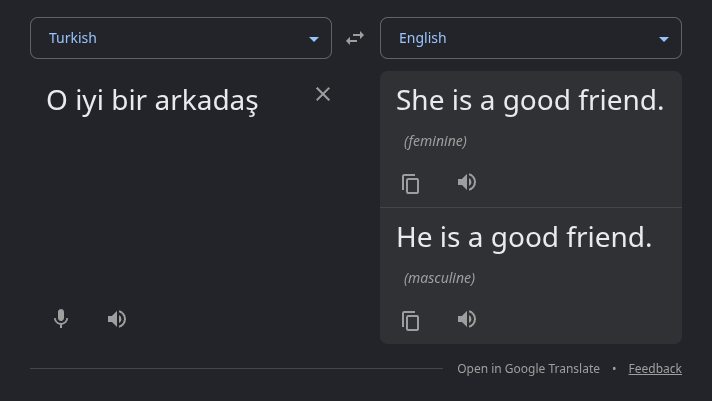
Also, never really knew that google translate could do multiple translations. In my language learning journey, I’ve also observed that it is extremely good at reconizing language nuances. Bravo!
The history of it doesn’t really interest me, but I did come across another mind bender while researching this. Genderless pronouns are not only not uncommon, they are actually the global majority!1
I only wanted to know what something like this means for native speakers. Apparently, native speakers are able to make everyday communication work because they identify referents through context, names, and noun phrases. Also, the language not having gendered pronouns doesn’t mean that gender cannot be expressed at all. Turkish speakers use explicit gender words when it matters. For eg. kadın doktor (female doctor) or erkek doktor (male doctor).
The ambiguity becomes more troublesome in translation than in Turkish conversation. A language like English may require a choice among he, she, or it, but the source language may not be able to supply it, leaving translators to infer from wider context. Machine translation illustrates the risk, as shown in this 2021 study, which found that systems translating neutral Turkish into English have sometimes selected he or she according to occupational stereotypes rather than evidence in the sentence.
Footnotes
-
According to data surveyed in the World Atlas of Language Structures (WALS), roughly 55% to 58% of the world’s languages make no gender distinctions in their independent personal pronouns. More information here