Pramod shared this video on our linkedin chat.
He’s introduced by Gaurav, who says that Pramod doesn’t view humans simply as detached relational agents, but with emotions, biases, and creativity, all of which shape their reality.
His talk, and the accompanying presentation, is titled “Am I a Behavioural Designer”
Notes from the talk
Chapter 1: What is Behavioural Design?
Q: What is design?
A: Changing the current situation to the desired situation
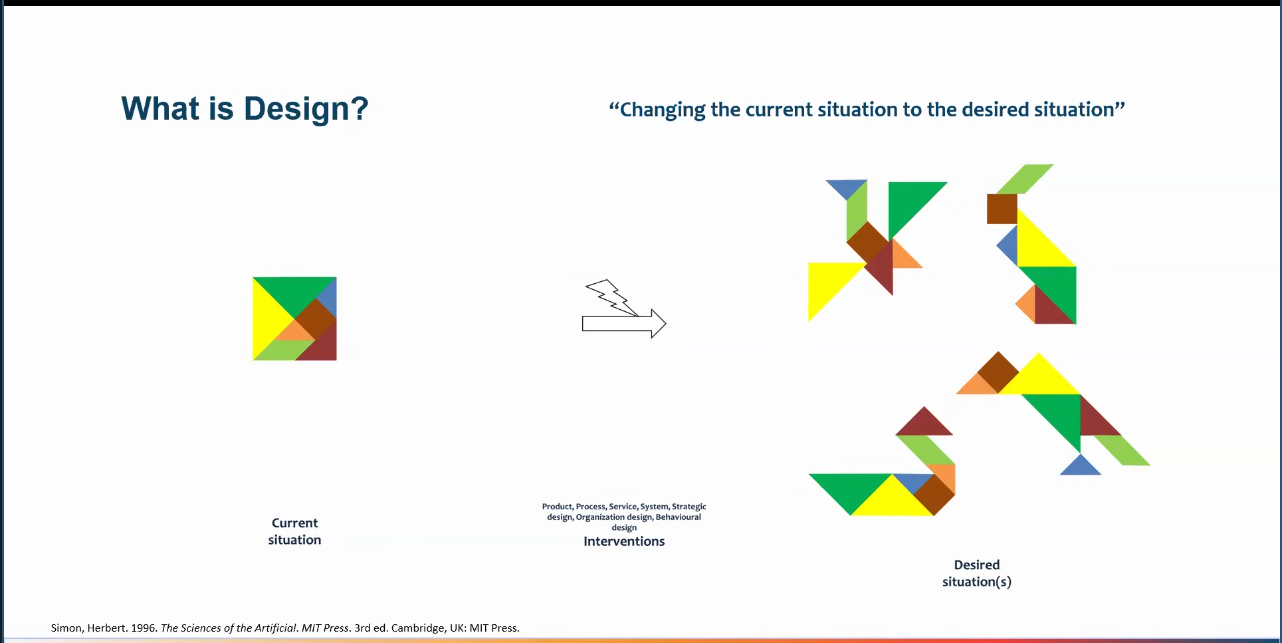
For eg. Given the set of tiles on the left, how can I create something meaningful (the shapes on the right)?
When thinking about a problem, designers usually say that they “create interventions”, which I interpret as them making deliberate actions or a series of steps so that the user can go from current situation to desired situation.
When designing these interventions, 2 things are extremely important:
- Understanding the attributes of the current situation aka what really needs to be fixed
- Formulating the desired situation aka where exactly do we need to go
Statement: Design intends to fulfil the function
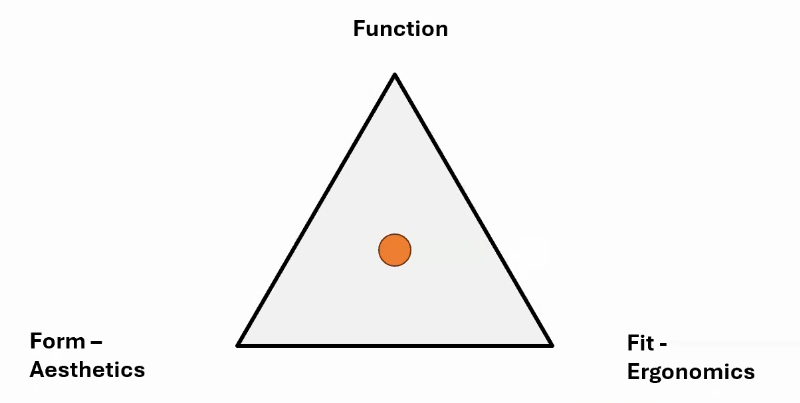
The dot at the middle tells you how much a product is designed for one particular aspect. In the centre, it focuses on all 3 equally, but products may be designed to focus on one area in particular.
Definition: Function
The function of a product is the intended and deliberately caused ability to bring about a transformation of a part of the environment of the product.
This was the statement given in the lecture. Let’s break it down:
- What is the environment of a product?
- The context in which the product is to be used. For eg. A football is meant to be used in a football field, which is its environment.
- Can a product have multiple environments? For eg. A mobile phone is supposed to be used in a person’s hand, but also in public places, rooms, etc. Are all of these its environments?
- What transformation is happening?
- Not sure yet
- Why a “part of the environment of the product”? Why not the entire environment?
- Not clear yet
Questions to think about
Q: Does a good technology/artifact lead to fulfilled functions? A: Not always, because for that to happen, it mainly depends on the end user using it well. For eg. A great running shoe isn’t great when it comes out of the factory for the first time. It becomes great when runners feel that it improves their function (i.e. running).
Pramod calls the things that make sure that a user can use a technology well “LifeCycle-related” Behaviours
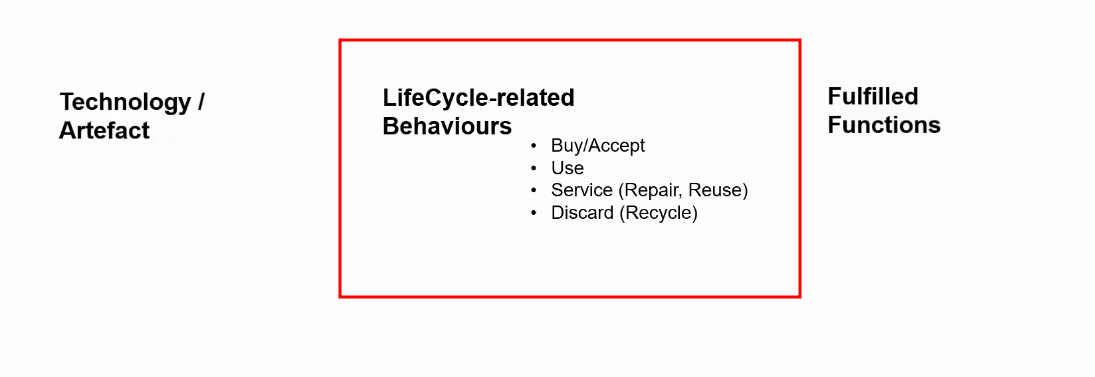
Q: Does a fulfilled function automatically lead to the desired situation? A: No. The function being fulfilled is only one aspect of the desired situation. What else does it demand?
The desired situation also requires the right behavior, which should sit on top of the function. For eg. for a suncreen to be used well, it has to be applied frequently and not just once in a day, which is not something that function alone will guarantee. Only a combination of these will make sure that the design of the sunscreen reaches its desired situation.
This leads us to think about the success of a design. Pramod defines it like this:
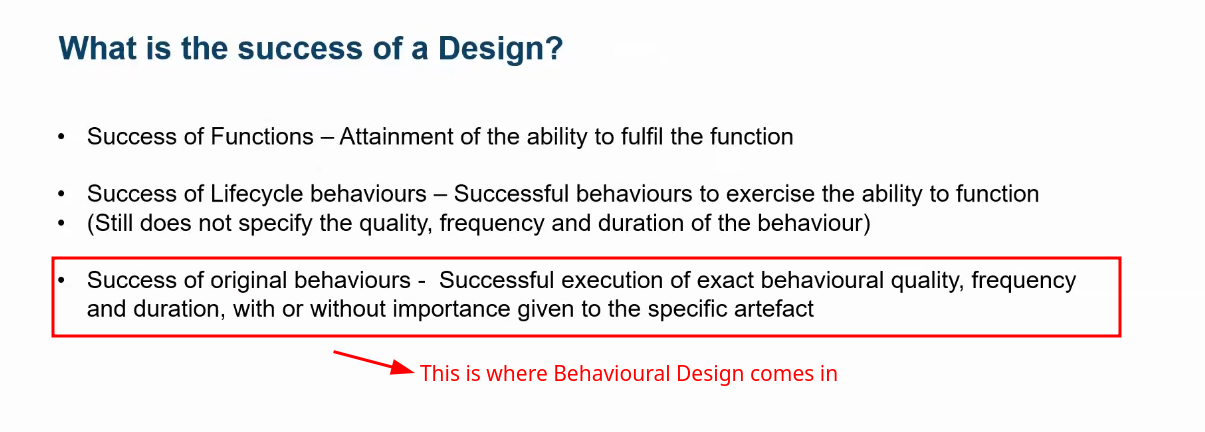
Summary: We discuss the essence of behaviour design and how it differentiates itself from other design fields.
Here’s what I think: There is a functional use of a product and an ideal use of a product. A good design can ensure that the functional use is achieved, but behavior design can make sure that the function of the product is achieved in the desired way, with the right behaviours.
The example of the anti-covid devices makes that clear. One (claw tool or smth) literally puts a device between you and your nose, while the other one (elbow strap) blocks the behavior by now allowing your arm to extend to the point that you’re able to touch your nose.
Chapter 2: What is the DNA of Behavior Design?
We start by this definition:
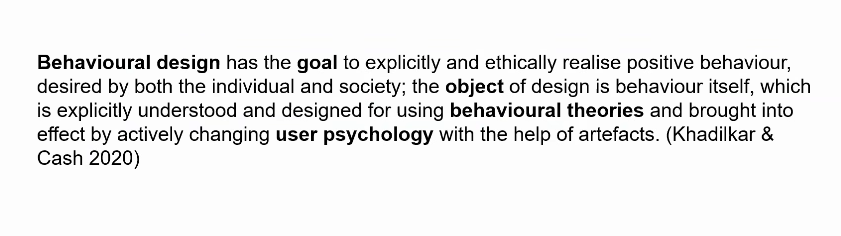
My understanding: The point of behavior design is to understand the current behavioural attributes and transform it by changing the user’s psychology through the employment of various artifacts. The object of design is not the product but the behaviour itself.
A behavioural problem is not a technical problem. For eg. When we say that people are not getting enough sleep, we usually point to the behaviours that cause this rather than blaming the bed or its quality. For eg. The behaviour of looking at one’s phone may be the actual reason behind the lack of sleep, in which case what needs to be fixed is the behaviour.
Stages of Behavioural design
Before we discuss these steps in detail, let’s look at an overview first:
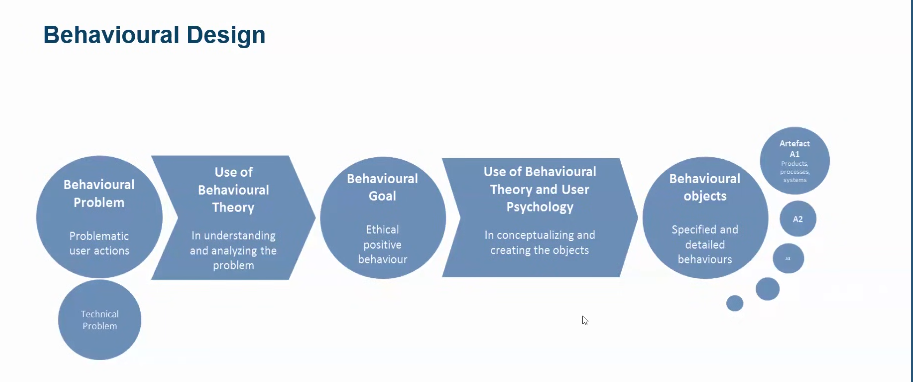
Behavioural Problem
In this stage, we try to understand what the problematic behaviour is. As mentioned earlier, it is important to get this right because everything we do after is based on the assumption that we’re addressing the right behaviour.
Use of Behavioural theory (to understand the problem)
We use our current understanding to develop insights about the problem and try to find patterns that can help us get closer to a solution. We analyze the problem in detail here, using our current understanding of the field. For eg. Some of the most commonly exhibit behaviours happen due to certain effects and biases, and these labels sometimes help us categorize the problem at hand.
Defining the Behavioural goal
We then try to define the ideal behaviour, or the desired situation. Continuing the example above, we’ll need to think of behaviours that stop people from using their phone at night. For eg. when your phone tries to nudge you to create a nighttime routine and recommends that you should be switching on DND mode to reduce interruptions, it is trying to create an interference (the nighttime routine) that transforms your current behaviour to an ideal one.
Use of Behavioural theory (to formulate the solution)
The initial employment of this information was towards understanding the problem. Now we’ll look at the aspects of the theory that can help us solve the problem, or in other words, create the behavioural objects.
Creation of Behavioural objects
Not sure why these are called behavioural objects and not just behaviours, because they seem like the same thing to me.
Question: What is behaviour?
Let’s look at the statement given in the slide first:
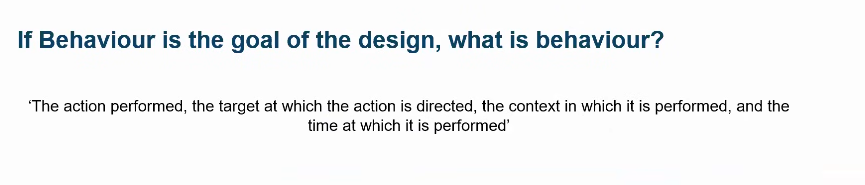
This seems to imply that a behaviour has multiple aspects to it. Let’s break down this statement:
- The action performed: This is the concrete behaviour. For eg. The setting of the nighttime routine on the phone, continuing our example from above.
- The target at which the action is directed: In our above case, the user seems to be the target. I can understand why that could be part of the behaviour, but still slightly confused
- The context in which it is performed: This could mean things like the physical surrounding.
- The time at which it is performed: Pretty self-explanatory
The statement basically implies that a behaviour cannot be understood if just looked at in isolation wrt any of these aspects or dimensions. To get the complete picture, you must have information from all of these dimensions. For eg. If the behavior is just setting up the nighttime routine, we cannot make an intelligible guess about what the nighttime routine is for unless we know other contextual information about the environment in which the behaviour exhibits itself.
If I were to explain my example behaviour in the dimensions discussed above, I could say something like this: A nighttime routine is set on a phone by a user when they’re about to go to bed at night, so in an attempt to reduce interruptions and sleep better.
Chapter 3: Theory of Planned Behaviour
What leads to the creation of a behaviour?
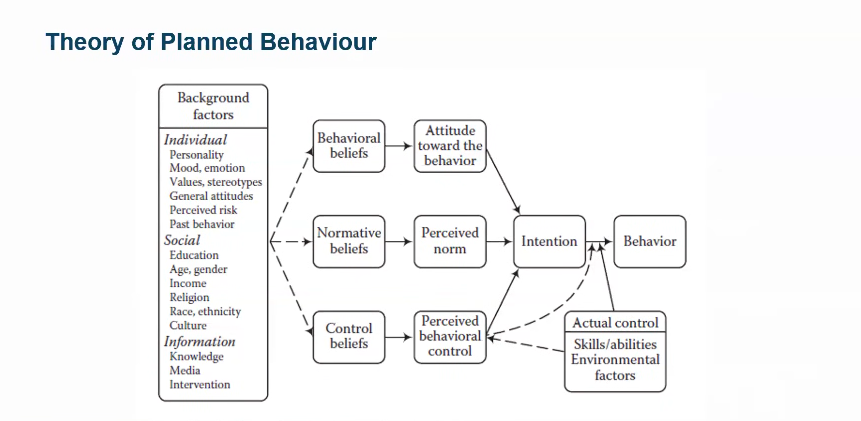
The main question this theory answers is: how does a person arrive at a certain behaviour, or why do they think that it is the right behaviour for them?
It says that there are 3 main controlling factors (beliefs) involved here:
-
Behavioural beliefs: The person’s own beliefs towards the behaviour.
For eg. if I believe that waking up early is important for productivity, then I will try to push myself to wake up early, but a night owl will not have these beliefs, and they will not give any emphasis to waking up early.
Note: This definition kind of feels incomplete because the slide didn’t attempt to answer how the person came to have those beliefs in the first place.
-
Normative beliefs: What the society or culture around a person feels about a behaviour.
For eg. if smoking and drinking is generally considered bad within one of my friend groups, then I’m also less likely to do it, since I’m always trying to get along with my friends and gain their approval. In a different friend circle, it might be encouraged and I might be influenced to do it as well. Parents, spouse, and to some extent, the larger society in general also play a role.
-
Control beliefs: The level of confidence I have in my ability to exhibit this behaviour.
A personal example comes to mind. As recently as a couple years back, I used to be very introverted and felt very awkward approaching people and talking to them, but then I realised I’m not being an introvert by choice but due to the fear of perception, and this lead to me gaining confidence steadily and allowing me to freely talk to people.
The COM-B theory of Behaviour
This theory says that a certain behaviour can only be created or come about when certain conditions are met
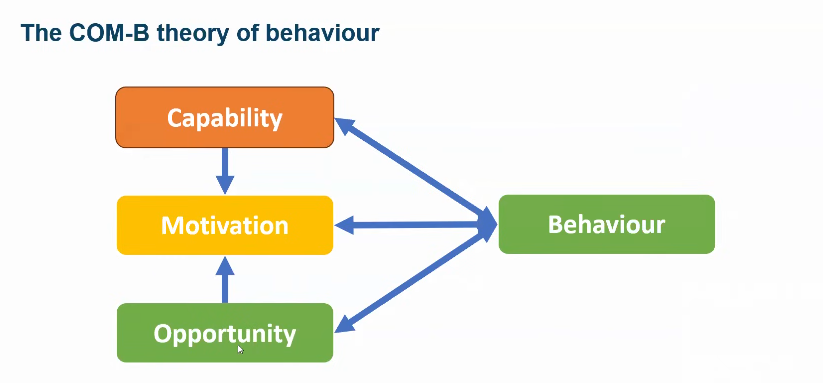
Question to self: Don’t the arrows seem inverted here? I was assuming all these factors would lead towards the behaviour, or maybe it just means to say the same thing just in a different manner (this is confirmed by how Pramod says it in his slide).
Also, why are capability and opportunity going towards motivation? Perhaps because motivation is the most important aspect and the presence of both capability and opportunity creates the motivation for a behavior to come about.
Chapter 4: How is Behavioural Design different from Behavioural Science?
I stopped playing the lecture at this point, because the contents from now on don’t seem relevant to my current inquiry